SBD vs AUD vs Matrix: A Guide to Live Recording Sources
Every show has more than one recording. The soundboard feed from the house engineer, two audience tapers stationed in different spots, maybe a matrix blend that someone spent weeks perfecting at home. Same night, same songs, totally different listening experiences. The abbreviations you see next to recordings (SBD, AUD, MTX) tell you what you're about to hear before you press play. Here's what each one means, how it sounds, and when to reach for it.
SBD (Soundboard)
A soundboard recording is taken directly from the mixing console. The signal travels from the microphones and instrument pickups straight to the board, and the recording captures that feed before it ever hits a speaker. You hear what the sound engineer heard: clean, dry, every instrument separated in the mix.
The upside is clarity. You can pick out individual notes in a dense jam, hear the subtlety in a quiet passage, and catch details that would disappear in a room full of people. There's no crowd noise, no room reflections, no artifacts from the venue acoustics.
The downside is that same isolation. A soundboard recording can sound sterile. There's no sense of space, no feeling of a room full of people reacting to the music. Sometimes the mix was built for front-of-house speakers and never intended to stand alone as a recording, so certain instruments sit too far forward or too far back.
The Grateful Dead's Betty Boards are some of the most prized SBDs in existence. Recorded by Betty Cantor-Jackson during her tenure as the band's recording engineer, these tapes captured shows with remarkable fidelity. Pull up 1977-05-08 at Cornell's Barton Hall and you hear every note Jerry played like he's in the room with you. The Scarlet Begonias > Fire on the Mountain from that night is a masterclass in why people chase soundboard sources.
AUD (Audience Recording)
An audience recording is made by a taper standing in the crowd with their own microphones. The mics capture everything: the music coming out of the PA, the room reflections off walls and ceilings, the crowd cheering, the person next to the taper yelling the wrong lyrics. You hear the show the way someone in the audience heard it.
The upside is presence. A great audience recording puts you in the venue. You hear the way bass fills an outdoor amphitheater differently than a hockey arena. You hear the crowd lose their minds when the band drops into a song nobody expected. That energy is impossible to fake and impossible to capture from a mixing board.
The downside is variance. Quality depends on the taper's equipment, their position in the venue, and sheer luck. A taper next to a loud talker or under a balcony overhang is fighting physics. Wind at an outdoor show can ruin an otherwise perfect recording. Two tapers at the same show, twenty feet apart, can produce recordings that sound nothing alike.
Some of the best AUD recordings come from tapers who spent years perfecting their setups. A Schoeps MK4V rig in the right spot at Red Rocks can capture something a soundboard never will: the way the music moves through open air, bounces off the natural rock formations, and settles over a crowd of thousands. That sense of physical space is what draws people to audience recordings even when a clean SBD exists.
MTX / Matrix
A matrix recording blends a soundboard source with an audience source, mixed together after the fact. The idea is straightforward: take the clarity and separation of the SBD, then layer in the room feel and crowd energy of the AUD. When done well, a matrix sounds better than either source on its own.
The quality depends entirely on who did the mixing and how carefully they matched levels, timing, and EQ between the two sources. A careless matrix sounds like two recordings playing at once. A great matrix sounds like you're standing at the board with the room alive around you.
Charlie Miller's matrices of Grateful Dead shows are legendary in the taping community. He would take a Betty Board SBD, layer in an audience source for room ambiance, and produce something that captures both the precision of the board and the feeling of being in the crowd. His matrix of 1977-05-08 Cornell is widely considered the definitive way to hear that show, blending the detail of the SBD with the electricity of the room.
Other source types you'll see
FM refers to recordings captured from a radio broadcast. Because the signal was mixed and mastered for broadcast, FM sources often have excellent sound quality with a polished, professional feel. DSBD (Direct Soundboard) means the recording was taken before the front-of-house mix, capturing the raw signal from each channel. Pre-FM is the tape that existed before the broadcast was edited for air, usually preserving songs or banter that got cut. Webcast recordings come from official or unofficial live streams and vary in quality depending on the source bitrate and encoding.
How to choose
It depends on what you want from the listening experience. If you want to study the music, trace every note through a jam, and hear the interplay between instruments, reach for the SBD. If you want to feel like you were standing in the crowd, hearing the room come alive, go with an AUD from a taper you trust. If you want the best overall listening experience and someone has put in the work, a well-made matrix is hard to beat.
Some shows only have one source. A single audience tape from a taper who happened to be there with a recorder in their bag. In those cases, you take what exists and appreciate that someone had the instinct to press record. Not every night gets preserved. The ones that do, preserved by communities like the Live Music Archive, are worth hearing regardless of the source type.
How Showboard handles this
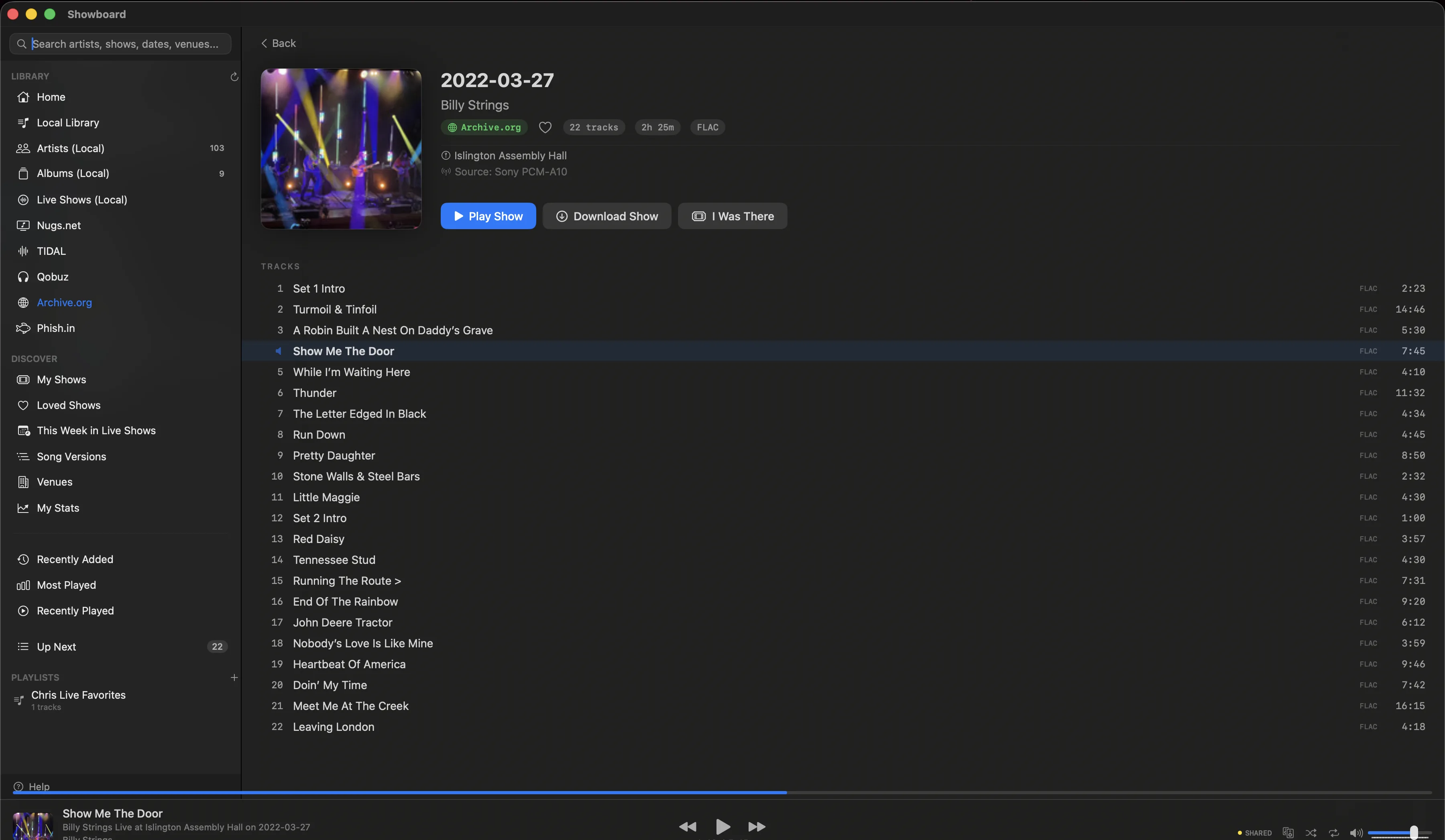
When a show has multiple recordings available, Showboard labels each one with a source type badge: SBD, AUD, or MTX, visible at a glance. You don't have to parse file names, dig through metadata, or guess based on folder structure. You see the badge, pick your source, and play. If a show has three audience recordings and a soundboard, all four appear with their source type clearly marked so you can choose the version you want in seconds.
Every recording is someone's decision to preserve a night of music. Whether it's a pristine SBD from a professional console or a rough AUD from someone with a minidisc recorder in their jacket pocket, it's a piece of a night that happened once and will never happen again. The source type just tells you which seat you're sitting in.
Related posts
Try Showboard free for 14 days.
Download for Mac