Why I Built Showboard
Sabrina and I keep ticket stub books. Actual physical books, with plastic sleeves, organized by year. We have been doing this since before we started dating. When we moved in together the books merged and the collection got serious. Hundreds of shows. Phish, Dead & Company, Goose, Billy Strings, Umphrey's, Trey solo, Phil Lesh, and dozens of one-offs we barely remember until we see the stub.
One night last year we were on the couch flipping through the 2019 book. Sabrina pointed at a stub. Phish at The Gorge, July 12, 2019. “Pull that one up.” I knew exactly what she meant: find the recording. Listen to it. Be back there.
So I opened Phish.in on my laptop. Found the date. Started the first set. But I also had a soundboard from nugs.net for that same night, and I remembered a Matrix recording from Archive.org that someone posted in the lot thread. Three sources for one show. Three different apps. Three searches. And I had to remember which one had the version of “Tweezer” that went deep into that 30-minute jam.
This was not a new problem. This was every time.
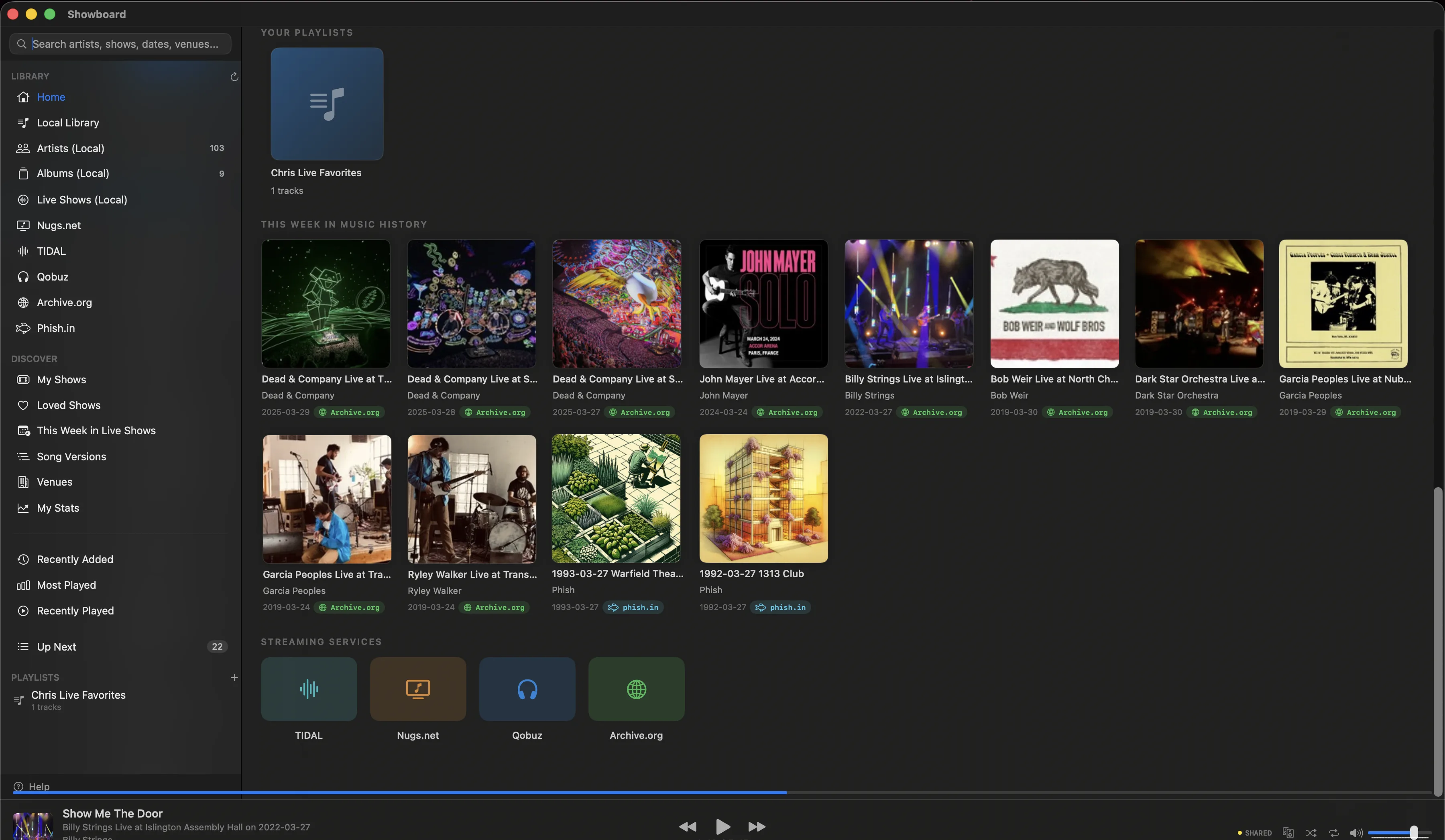
Every show, the same juggle
Think about MSG New Year's Eve. December 31, 2023. You were there. The gag was unreal. You want to relive it. Nugs has the official webcast audio. Archive has an audience recording that captures the room in a way the SBD never will. And maybe you pulled the FLAC from the live Phish release and it's sitting in a folder on your hard drive called “MSG NYE 2023 SBD 24bit.” Great. Now open three apps.
Or Red Rocks. Pick any summer. Trey Band, Billy Strings, Goose. Half the recordings are on Phish.in or Archive.org. Half are on nugs. Some you taped yourself, or a friend sent you an SBD over Google Drive. The music is scattered across apps that do not know each other exist.
Every time Sabrina pointed at a stub, the same thing happened. I knew the music was out there. I just could not get to it without a scavenger hunt.
Nobody had built this
I looked. Roon is beautiful, but it is built for studio albums and classical music. It does not know what a set break is. It has no concept of a taper or a source type. Audirvana is built for audiophiles who care about the signal path, which I respect, but it does not know what SBD means. Neither of them can pull a show from Archive.org or Phish.in.
The taper community built conventions over decades. SBD, AUD, Matrix. Set I, Set II, Encore. Taper notes. Venue names. These are not metadata afterthoughts. They are the vocabulary of how collectors think about live music. And no player on earth treated them as first-class concepts.
Every player I tried was built for a world where music means studio albums. Where an “album” is 12 tracks by one artist released on one date. Live music does not work that way. A single night might have three different recordings from three different sources at three different bit depths. The player needs to understand that.
So I started building
I am a developer. I have been writing software for a long time. And I kept thinking about this problem in the way you think about something when you know nobody else is going to solve it. Not because it is too hard. Because the audience is too specific. The intersection of “audiophile” and “live music collector” and “wants one app instead of six” is not a market that venture capital gets excited about. It is just a group of people I happen to belong to.
The core idea was simple. Six sources, one library. Local files, nugs.net, TIDAL, Qobuz, Archive.org, Phish.in. All searchable from one place. Type in a date, see every available recording from every source. Set breaks, source badges, taper notes, venue info. The things every collector cares about, built into the player from day one.
It had to be a native Mac app. Not Electron, not a web wrapper. A real macOS application that could talk to CoreAudio directly, handle exclusive mode for bit-perfect playback, and feel like it belonged on the platform. That decision meant it could not go on the App Store, because Apple's sandbox blocks the CoreAudio HAL access required for exclusive mode. I was fine with that trade. Bit-perfect output is not optional for an audiophile player.
The name
Showboard. A board for your shows. That is the whole explanation. I liked that it was literal and that it sounded like something you would actually say. “Let me check my showboard.” It stuck immediately.
What it became
Once I started using it daily, I realized the player was just the foundation. I kept wanting things that did not exist yet. A concert diary that tracked every show I had been to, with the recordings attached. A venue explorer that let me browse by location and see what was available. Song version comparisons across sources, so I could find the best “Stash” or the longest “Down with Disease” and hear it in SBD or AUD or Matrix.
Then the I Was There card. You pick a show, Showboard generates a card with the setlist, the venue, the date, and a gradient pulled from the show data itself. It is the kind of thing you want to text to the friend who was standing next to you. That feature came from using the app and noticing what was missing. The best features always do.
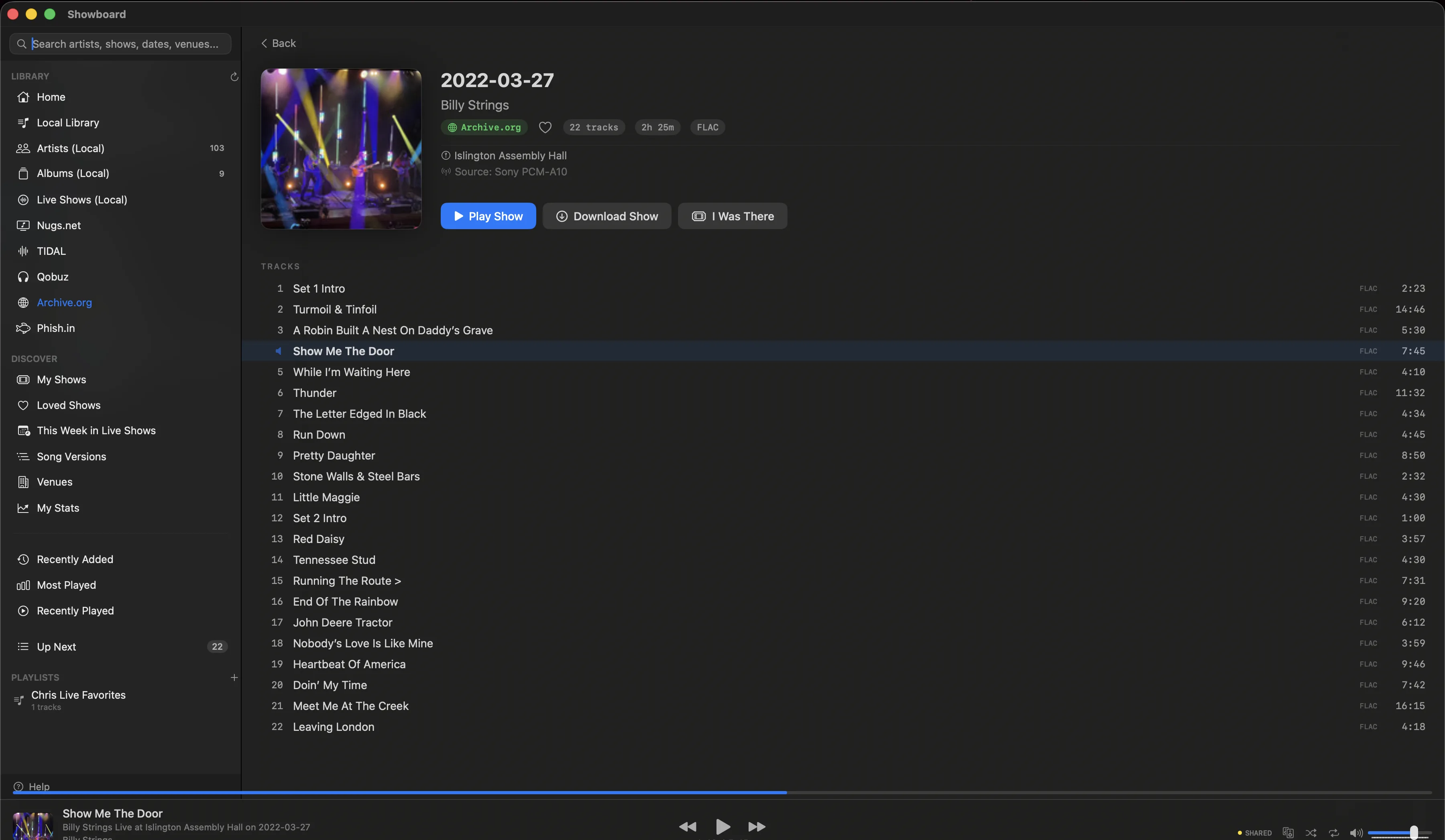
The price
$39.99, one-time. No subscription. I thought about this a lot. After years of paying monthly for apps that half-work, for streaming services that rotate their catalogs, for software that holds your data hostage behind a recurring fee, the model should be simple. Pay once. Own it. Get updates. That is the deal. A 14-day free trial so you can make sure it fits your setup, and then a single purchase. No surprises.
Why it matters
Those nights meant something. Standing in the rain at The Gorge with 15,000 people while “Tweezer” dissolves into something nobody has heard before. The countdown at MSG with confetti stuck in your hair. The drive home from Red Rocks at 1 AM, still buzzing.
The recordings are how we get back there. And they deserve better than three tabs and a prayer. They deserve a player that understands what they are.
If you have been to the shows, you know. Showboard exists because of that knowing.
Related posts
Try Showboard free for 14 days.
Download for Mac